ANDRERIEUMOVIES.COM

NRC Handelsblad
interviewing article September 22, 2026.


September 22, 2026, sharing a very nice long interviewing article from NRC Handelsblad,
by Coen van Zwol, photos Chris Keulen and fans.
Translation Diana D. Le
André Rieu is the Netherlands' biggest music phenomenon: 500
platinum albums, and with 11.5 million tickets sold, he ranks somewhere
between Beyoncé and Madonna
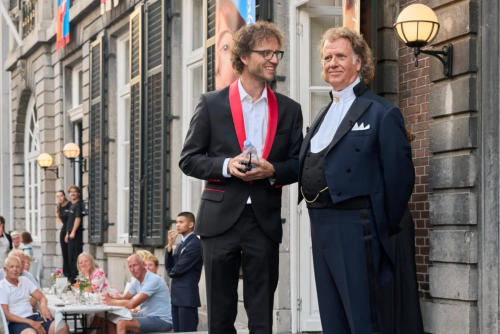
Both André Rieu and Pierre Rieu join the conversation
with journalist editor Coen van Zwol.
After another series of sold-out Vrijthof concerts this summer in Maastricht, André Rieu will be touring
Europe in the coming months with his Johann Strauss Orchestra—the largest private orchestra in the world.
André Rieu: “For me, it’s always about direct contact with the audience. Otherwise, you might as well just
put on a record.”
André Rieu (76) looks a bit pale, a week before his annual series of twelve concerts at the Vrijthof in
Maastricht. He stayed up too late last night to watch the Germany-Ecuador soccer match. “1-2. Those
Germans must be mortified,” he beams.
It’s June 26, and Maastricht is sweltering under a heat wave. Yesterday, it was 38°C. Yet at dusk, André
Rieu still took a short video of himself marching through the hilly countryside with the Koninklijke Harmonie
Sainte Cécile Eijsden.
“They’ll be playing at the Vrijthof shortly. Before we start ‘Il Silenzio’ there, I’ll tell the audience that every
little village in Limburg has a brass band and that’s why we have such amazing brass players. But I wasn’t
satisfied with the images of Limburg on the background screen.”
Son Pierre Rieu: “I thought: 'You’re not going to let those recordings go ahead because of the heat.'”
André: “They also said, ‘We’re not going to put those suits on, you know.’ But then they said, ‘Okay, if that’s
what André wants.’ And it wasn’t so bad—there was a gentle breeze. Up and down twice, and we were
done.”
In Limburg, André Rieu’s word is law. He’s a perfectionist who insists on punctuality and can fly off the
handle if a technician visibly walks through the frame during a concert. Everything has to be just right. He
says he still gets pretty nervous before concerts—especially about his scripts in all those languages.
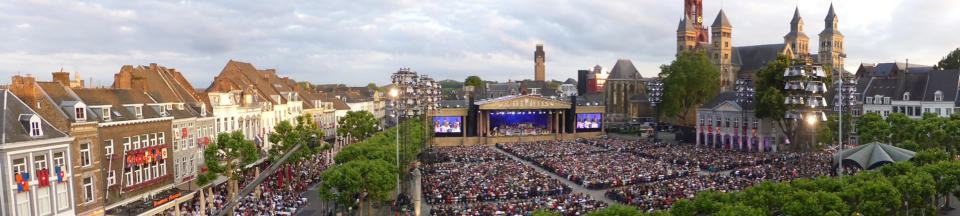
This summer, Maastricht is hosting the Vrijthof Concerts for the twentieth time. The city is plastered with
posters, the Markt turns into a parking lot for tour buses, and 8,000 seats await Rieu fans on the Vrijthof.
From the outdoor dining areas, another 4,000 people will watch the concert as part of a dinner
package—the concerts attract some 150,000 visitors.
André Rieu is the Netherlands’ biggest music phenomenon. His record sales have gone platinum 500 times
worldwide; according to Pollstar, the concert industry’s data site, he is the 14th-biggest live act of the 21st
century with 11.5 million tickets sold: slightly bigger than Madonna, slightly smaller than Beyoncé. His
YouTube channel, [https://www.youtube.com/channel/UCAaX9NjMCos_Qwz3n41eUgg, has 6.96 million
subscribers, and his 845 videos garner over 4 billion views]. And his Johann Strauss Orchestra is the
largest private orchestra in the world, with annual revenue of around 70 million euros.
His son Pierre (45), managing director of André Rieu Productions, wasn’t too thrilled about this interview.
Dad had already agreed to it, but he really needs to focus on the concerts. “But you’re welcome to
stay—you’re here now anyway.”
Pierre always pops up somewhere during concerts: in the choir, as a bagpiper. It’s a tradition. He was
already working for his father as a teenager: soundchecks, technical work, planning tours. “I’ve done almost
everything within this organization. When I was eleven, I was already riding in a truck like that—I was
allowed to press the button for the tailgate. Nobody took that away from me.”
The downside was that he was saddled with too much responsibility far too early, Pierre recently
complained on Nieuwsuur. He often had to keep an eye on his father instead of the other way around. Now
he does so gladly, he says. “My department is big, but Pierre’s department is wise,” says André.
Ever since he was sidelined for three months in 2011 due to an infection in his vestibular system, André
Rieu has been more mindful of his health.
Pierre: “When Dad gets sick, everything here comes to a halt. While on tour in Mexico, he was sidelined for
a while—that’s a financial loss amounting to millions.”
His company already needs about 1.3 million euros per month even when he’s not on tour, so André Rieu
exercises daily, no longer drinks alcohol, and takes a nap before every performance.
At the Vrijthof
On Thursday, July 2, the Eijsden brass band will march across the Vrijthof as a warm-up. Volunteers in red
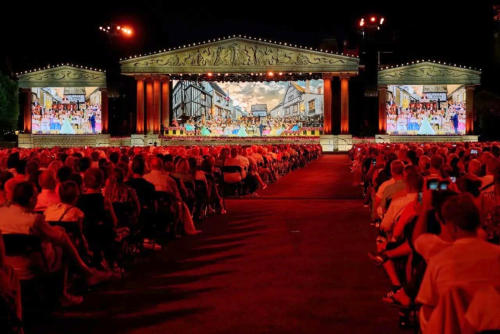
piccolo uniforms will show the audience to their seats; the stage is a quasi-Greek temple with a huge
screen on which natural landscapes and cityscapes will be projected.
Fans come from all over the world. I speak with Vicky and Chris from Guildford, England, who had Rieu on
their bucket list. “Once you’re over seventy, you never know how much time you have left.” A couple from
Australia was at the Concertgebouw yesterday for the Stravinsky concert. They say you enjoy Rieu in a
completely different way. Wil and Minke from Haarlem, who have been following Rieu for thirty years,
received tickets from their daughters. They’re thrilled that from row seven, you can almost touch André
Rieu.
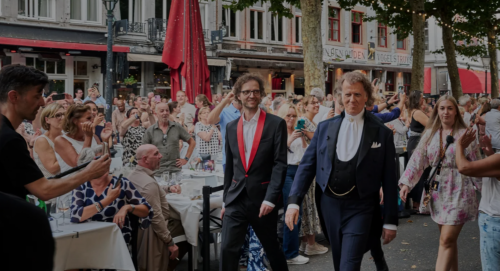
At nine o’clock sharp, Pierre welcomes his father to the Vrijthof. André Rieu leads his orchestra through the
audience to the stage: the men in tailcoats, the women dressed as Disney princesses. This entrance from
the audience was once a practical necessity, Rieu explains later, when he moved from theaters to event
halls and the orchestra could no longer wait behind a curtain. “But it works wonderfully, because it
immediately draws the audience in.”
With André Rieu, you’re not supposed to sit still. His repertoire is a medley of light classical, marches,
operettas, pop music, movie themes, and schlager, with the Viennese waltz as its constant anchor. The
setlist varies, but the structure doesn’t: it’s an emotional roller coaster of serious and lighthearted moments,
with highlights such as the entrance of his three Platin Tenors or 150 dancing couples from Maastricht
waltzing through the audience.
André Rieu acts as a “Stehgeiger”—a violinist who also conducts—linking the audience and the orchestra
with casual banter. True fans know his lines by heart. About pan flute player Michel Tirabosco, who was
born without hands. About the first time he rehearsed with his orchestra in the winter of 1987, in a freezing-
cold school building and warmed his fingers with a mug of hot soup made by his wife, Marjorie.
Flutist Teun Ramaekers stands up: he was there back then, and tonight he’ll once again get hit with a foam
hammer when he lets loose with a jazzy solo. Another founding member, clarinetist Manoe Konings, is
drinking “on the sly” behind Rieu's back, as usual—this time, a stolen glass of sparkling champagne.
No Schmalz without Scherz (No sentimentality without a joke): on stage, André Rieu is a father figure who
sometimes raises an eyebrow menacingly, but good-naturedly lets his authority be undermined by the
mischievous troublemakers in the orchestra and the audience.
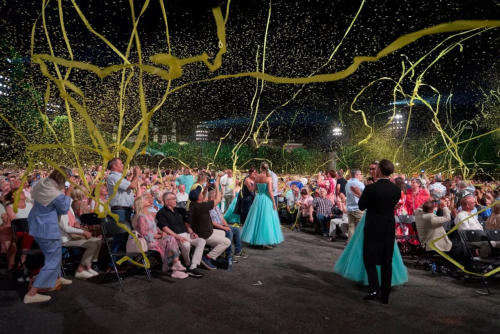
After the intermission, the excitement builds toward the grand finale, complete with fake snow and streamer
cannons. “We’re done for now; you all need to go to bed,” Rieu calls out. “No,” the audience replies, like
naughty children. “Go to sleep!” “No!” This is followed by an endless string of encores: swaying turns into
dancing, and the waltz gives way to Maastricht hits and party songs. The audience waves napkins and
cheers for the fireworks.
I hear that André Rieu enjoys those encores the most. That’s true, he says a week after the Vrijthof
concerts. His love for the waltz began with his father’s concerts. “That was heavy stuff—Beethoven, Ravel,
or Messiaen. But at the end, the lights would come on and he’d play a waltz by Strauss or Lehár as the
grand finale. As a child, I thought that atmosphere was fantastic; you could see the audience perk up.”
Unlike his father, he actively engages the audience throughout the entire concert. “I know exactly how to
build up to that climax over the course of two hours. It’s kind of like good sex. First, a very long foreplay, and
then…”
“That was quite a long orgasm,” I say: seven or eight rounds. Rieu: “Yeah, but that’s nice, isn’t it! Afterward,
they’re really satisfied, completely spent. Sex is the best thing there is, isn’t it? Oh my, what am I saying?”
The Rieu Family
There was never any chance for son Pierre to join the orchestra. “Dad tried to get me into it; I still have
photos from my violin lessons: I’m deathly pale, and every muscle in my face is tense. So we stopped that.
As a child, Dad was determined to play an instrument himself; he knows how much suffering that caused.”
André Rieu: “I didn’t choose a musical career for myself—it was chosen for me. I had to play the oboe and
the piano; the teacher was a terrible person. I was also in the church choir, and every Wednesday and
Saturday, I had singing lessons and solfège. It was incredibly boring, but I had to do it, didn’t I?”
He did enjoy the violin, though. “I had a very nice and pretty 18-year-old blonde as my teacher. I thought her
vibrato was so beautiful, the way she demonstrated it. I was incredibly proud when I could do it too. That’s
when I knew I wanted to be a violinist.”
But he preferred to play outside. André Rieu: “Mom would yell ‘Practice!’ from upstairs whenever she heard
I was getting distracted. Beethoven was dragged out of bed at night by his drunk father. ‘Go on, play!’
Chopin, too. I thought: I’m not going to do that to my own children; I don’t want to force them.”
Pierre: “No, we had other things to do.”
André Rieu’s father was André Rieu Sr. (1917–1992), a Catholic Dutchman who conducted the Limburg
Symphony Orchestra (LSO) from 1949 to 1981.
André Rieu: “Back then, you were a conductor for life. Willem van Otterloo, Rogier’s father, also led the
Residentie Orchestra for half his life. After twenty or thirty years, an orchestra like that would start to run
less smoothly. Times changed, but the conductor didn’t.”
At the Rieus’ home, only serious classical music was played—Brahms, Beethoven—and well-known
soloists and composer Francis Poulenc were regular guests—Rieu Sr. had a soft spot for contemporary
French classical music.
He himself found the atmosphere stifling. “It just wasn’t fun at home. My oldest sister couldn’t handle it
mentally. My other sister passed away; then comes me, followed by my brother Robert, who fled to
Marseille and spent his entire life there as a cellist with the opera. Then I have another brother and a
younger sister—they’re the youngest ones. I don’t have much contact with them.”
Rieu was a musical talent; he attended the conservatories in Maastricht, Liège, and Brussels, and took
lessons from Herman Krebbers, the violinist whose charisma he admired. Rieu graduated from the
conservatory with a Grand Prix, but in the mid-1970s found himself in a “late adolescence.” “When I met my
wife Marjorie, I didn’t know anything about The Beatles or The Rolling Stones. I caught up on that.” He
considered opening a pizzeria. “Pizza Paganini—the idea was that I’d sometimes come out of the kitchen to
play the violin for the customers.”
That didn’t happen, “and thank goodness for that.” In 1978, Rieu became a violinist with the Limburg
Symphony Orchestra: he found the experience bureaucratic, routine, and joyless. To earn some extra
money, he joined the chamber orchestra I Glissandi, which later became the Maastricht Salon Orchestra.
André Rieu: “Salon music from the early 20th century was coming into fashion at the time; the Hague
Residentie Orchestra was the first to take it up. For them, it was just a bit of dabbling, a hobby. I took it very
seriously. Marjorie said, 'You play ‘Bummel Petrus’—a well-known salon piece—as if it were Beethoven."
His salon orchestra gained a reputation for special events such as the Mother’s Day concert in Heerlen or
the “Hieringbiete-konzèr” in Maastricht on Ash Wednesday after Carnival, when Lent is ushered in with
herring and beer. He even scored a top-10 hit in Belgium: Toselli’s “Serenade” featuring a nightingale as
soloist.
More than awful
André Rieu: “My parents thought that salon orchestra was more than awful. I didn’t care—they’d kicked me
out of the house anyway. When I started dating Marjorie, it was pretty much like the Hiroshima bomb.
Marjorie and her family weren't good enough for them; everything was always about status and hierarchy.
It was really harsh. They sent a registered letter saying, 'We’d rather not have you over anymore.
I remember what a relief it was to live in a regular little apartment, among regular people. Then the doorbell
would ring, and the woman who lived downstairs would come up and ask, 'Hey, Jo, want to meet up
sometime?' And my in-laws were my biggest fans.”
But André Rieu refuses to accept that his popular repertoire is a rebellion against his father. “I’ve always
been different from my family—maybe because I was cared for by the district nurse for the first three
months; my mother had anemia. That’s when your destiny is set.”
His mother belittled his talent and his choices, though she did call when the Maastricht Salon Orchestra
was performing on the radio from the Concertgebouw in Amsterdam. “Then suddenly it was interesting after
all.” André Rieu Sr., who considered Johann Strauss a genius, attended “half a performance” of his Johann
Strauss Orchestra before his death and sent a note. “Saying that he did, after all, have respect for what I
was doing now. But that was just a little note, you know. It was almost impossible to have a conversation
with him toward the end of his life.”
Still, he does have something in common with his father, he says. “He was also a smooth talker, just like
me. He would perform Messiaen’s ‘Les Oiseaux’ for schoolchildren and explain it to them beforehand. The
board called him out on it, saying it was too childish. And his rapport with the audience was very
authoritative, like a teacher.”
I remind Rieu of an old quote. He once reproached his father—when the latter was conducting the Leipzig
Opera—for the fact that the audience could see nothing of him but two hands and a baton. “It’s all about the
music,” said Rieu Sr. “With my orchestra, it’s all about me,” replied Rieu Jr.
He says he would phrase it differently now. “It was once Wagner’s idea to cram the orchestra into an
orchestra pit like that in Bayreuth, to serve the Gesamtkunstwerk (Total work of art). For me, it’s always
about direct contact with the audience. Otherwise, you might as well just put on a record.”
Shostakovich
In 1988, Rieu expanded his project to include the Johann Strauss Orchestra—modeled after the English
“Strauss Nights,” featuring Viennese waltzes and ballet. The orchestra toured Dutch and German theaters
and concert halls with great success, but remained under the radar of the national press. That is, until 1994,
when, after much lobbying in Hilversum, he managed to convince someone from the record label Universal
to attend a concert in Harlingen. That person was enthusiastic: Universal released André Rieu’s rendition of
Shostakovich’s “Second Waltz” as a single. It spent 52 weeks on the charts, and his album Strauss & Co
sold better in the Netherlands than Michael Jackson’s Thriller. André Rieu became a phenomenon; he
performed during halftime at the Ajax-Bayern Munich soccer game. The slogan: “No house, but Strauss.”
Universal saw him as a one-hit wonder, Rieu says now. “After Strauss & Co, they pretty much kept my
second album under wraps, even though it still sold 300,000 copies. They thought I was another Berdien
Stenberg—one little hit, and then we can all go home.”
Pierre Rieu: “To record executives, we’re not a sexy product. No afterparty at the nightclub where they all
get to have a little fun… (makes a sniffing sound). More like a cozy glass of wine, a brie sandwich, and a
croquette.”
André: “Do you remember when we were invited by Lucian Grainge, the head of Universal in Los Angeles?
As a thank-you for all our platinum records? What a bunch of scumbags.”
Pierre: “Such a tall tower—with every floor, the secretaries got prettier and their skirts got shorter. So, we
were waiting for our appointment, with loud R&B blaring from that office. A group of people who looked like
they’d been drinking came walking out, and then it was our turn. The place was covered with photos of
Grainge with Princess Diana and Elton John. Nothing to do with us, of course.”
André: “He didn’t want to be caught in our company.”
Near-Death Experience
Nevertheless, in the 21st century, André Rieu conquered half the world: Europe, Australia, Japan, Brazil,
Mexico, and the United States. Until he nearly went bankrupt in 2009.
André Rieu: “I’m not really one for budgets; I’m more of a ‘That sounds fun, let’s do it!’ kind of guy. We had
our big breakthrough in Australia in 2008—it was almost absurd. We had the entire top ten, and then
Beyoncé came on top of that. We went from performing in event halls to stadiums.
I thought, ‘We have to offer something extra there.’”
He had been inspired by a concert in the garden of Schönbrunn Palace in Vienna, and asked his son Pierre
to build a full-scale replica of the palace for the stadium tour “Romantic Night in Vienna.” “So that’s what he
did, in his youthful enthusiasm.” The set was 125 meters long, 35 meters high, and 30 meters deep,
featuring two ice rinks for figure skaters, 14 carriages drawn by 36 horses, and a replica of Schönbrunn’s
ballroom with 350 chandeliers. It weighed 600 metric tons and contained 160 kilometers of steel and
aluminum. The deployment required a battalion of 500 men. A logistical nightmare.
Pierre: “That tour in Australia was a huge success; everything was sold out. We made 26.5 million euros,
but the costs came to 29 million.”
André: “Our debt rose to more than 30 million euros. One Saturday morning, a bunch of guys from
Rabobank showed up at our house. They came to see what they could take from us.”
Pierre: “Some very angry guys.”
André: “I called Universal and my promoter in Germany. They each promised me 5 million on the
spot—after all, I was their goose that laid the golden eggs. Then the bankers called headquarters in Utrecht
and decided not to pull the plug after all. If I could raise 10 million euros in three minutes, the rest would
follow.”
Pierre: “The following year, everything went like clockwork, and we made 20 million euros in profit. We
made a breakthrough in the United Kingdom, partly thanks to YouTube videos of that Schönbrunn set. In
the long run, it was a fantastic investment.”
André: “England was really slow to catch on; at first, they didn’t like ABBA there either. I know what those
British record executives said: ‘My God, not another James Last.’ They’re pretty arrogant.”
After that business-related near-death experience, André Rieu promised to adopt a more modest approach
from then on—but his dream of bigger and grander things remains. For example, there was recently a stir
when the investigative platform Follow the Money reported that in 2024, André Rieu, along with Governor
Emile Roemer, lobbied European Commission President Ursula von der Leyen to secure a European
subsidy of 10 to 15 million euros. He wanted to use the money to fund a massive choir of 150 singers from
all over Europe to celebrate the 200th anniversary of Johann Strauss’s birth in 2025.
Pierre Rieu: “Von der Leyen hinted that it wouldn’t go over well for a commercial enterprise like ours to
receive a European cultural grant. After that conversation, we decided to drop the idea.”
Over the past ten years, Pierre Rieu has been very busy reclaiming the rights from record labels that his
father had gradually signed away, even during that near-bankruptcy.
André Rieu: “An orchestra always needs money, and they take advantage of that. 'Here’s an
advance—would you mind signing this?' And then the split for the next thirty years isn’t 80-20 percent but
20-80 percent.”
“For a long time, we had Wout van Liempt as our manager—a gentleman-rogue in one of those white
camel-hair coats. ‘Mr. Rieu,’ he’d say, ‘I’m offering you 150,000 guilders right here and now for all the
rights.’ ‘Come on,’ I’d say, ‘my cleaning lady makes more than that.’ But I figured, why not give it a try?”
Last year, his son Pierre celebrated the return of the final piece of the catalog: André Rieu Productions now
handles all music and merchandise in-house. And film: concert films in theaters are becoming a separate
revenue stream.
Three Crying Men
In late July, André Rieu is working on a new concert film shot at the Vrijthof, which is set to hit theaters in
late August. He proudly shows me around his rehearsal space and recording studio, which was recently
renovated and decorated in the style of a Viennese ballroom. “We want to stay up to date technically. Two
years ago, my guys told me that Dolby Surround is being replaced by Dolby Atmos in movie theaters. An
added bonus is that Spotify offers you something extra in that format.”
In the video editing suite, they search for 1.08 seconds of footage from pan flutist Tirabosco’s performance
that’s gone missing. A rough cut of the concert film is made during the performances; Rieu then fine-tunes
it and casts the audience for the “reaction shots”: emotional fans, but nothing over the top.
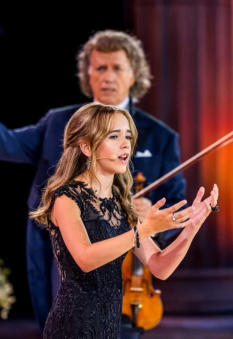
“Three years ago, without asking me, they posted a video online of the song ‘Voilà,’ sung by Emma Kok
[the then-15-year-old singer who suffers from gastroparesis and can only eat through a feeding tube].
Nothing happened—maybe ten likes or so. Then I found three men crying, and we edited them into the
video at just the right moment. After that, it got 110 million likes. I’m the one who brings that emotion to it.”
Rieu’s films avoid close-up shots of hands playing instruments, as seen in classical concert recordings.
“Little fingers on the piccolo or a bow across the bridge of the double bass: does that give you chills or
warm your heart?” That emphasizes virtuosity and creates distance. “The whole musician has to be in the
frame.” And what else? Don’t show the timpanist during a sensitive piece. “And when everyone sings along
at the end—lalala di-da, di-da, lalalala di-da—show the whole square in the frame, not just individuals.”
The Rieu Experience
He is on top of everything, says André Rieu. How much longer? For his 80th birthday tour in 2029, he
recently held auditions in Blackpool for a hundred ballroom dancers, and he wants them—just like on the
Vrijthof—to waltz through the audience all over the world. He plays the violin less during performances
than he used to, focusing instead on conducting. “I don’t want to end up like Joe Biden. The agreement
with Marjorie is: if she thinks I’m too old, I’ll stop immediately. This year, I made it through the jury."
Pierre: “As a family, we have a veto. We once saw the aging Pavarotti, and with all due respect: it’s a
shame no one told him, ‘Luciano, dear, it’s been a good run.’ He was wheeled to the microphone in a
mobility scooter, couldn’t hit his notes, and was out of breath.”
Last year, Maastricht held a debate on the unthinkable: a future without Rieu. A Limburg “cultural
entrepreneur” proposed converting the Bonbonnière in Maastricht—the former city theater dating from
1788—into an André Rieu Experience, featuring a Viennese grand café where Rieu concerts would play
nonstop.
Pierre: “The Elvis Experience would be a huge success in Las Vegas. But I think you have to watch out for
self-aggrandizement. My father has made a lot of people happy, but everything is fleeting.”
Can he imagine ever performing as a hologram, like ABBA? Or as an AI version?
André Rieu: “Well, no. I understand they’ve also made a statue of me. But they can wait until after I’m gone
to put it up.”
And that could take a long time, he says with a wink. He used to think he’d live to be 120; now he’s aiming
for 140. “I’m sometimes in touch with internist Andrea Maier about healthy aging; she was a guest on
Zomergasten (TV program). I found one of her statements particularly striking: ‘Aging is a disease.’ A
colleague of hers believes that the first person to live to be 1,000 years old has already been born. So, who
knows.”
André Rieu and his Johann Strauss Orchestra will be touring Central Europe in the coming months.
Starting December 11, 2026, the traditional Christmas concerts will take place at the MECC in Maastricht
and at the Ziggo Dome in Amsterdam on January 9, 2027.
Tickets: https://www.andrerieu.com/en
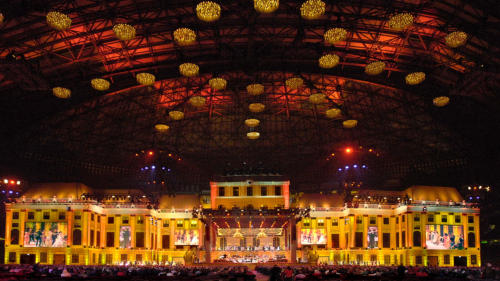
Replica of Schönbrunn Palace in Vienna.
Design Jaya Tgal: André Rieu, Maestro of the Universe
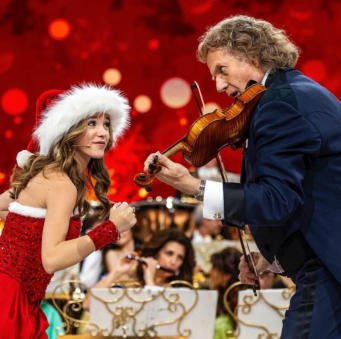
Emma Kok,
performing with
André.
from our own
archive.



- Maastricht Dinnertime
- Maastricht Preparations
- Tickets & accomodation
- Ticket Mediation
- Trains from Amsterdam Schiphol
- Trains from Brussels, Paris, Frankfurt and London
- Maastricht Fan Dinner
- Maastricht Fan Picnic
- Maastricht City Walks
- Maastricht Mosasaurus
- Daytrips from Maastricht
- Vrijthof news
- Maastricht Bonbonniere
- Maastricht ENCI quarry

- 2026 - 2030
- 2021 - 2025
- Previous items 2025 Jul - Dec
- Maastricht 2025
- Previous items 2025 Jan - Jun
- Previous items 2024 Jul - Dec
- Index of this period
- Doctor Peter de Beer
- Phil Bee
- Carlo Bonnie
- André’s Castle De Torentjes
- André gets his own stamp
- Typewriter artist
- Duo X-Elle
- Cinema experience 2024
- Quote Business Magazine
- Concerts in Bogotá, Colombia
- Margriet Magazine (1)
- Margriet Magazine (2)
- André Rieu turns 75
- André’s 75th birthday party
- Concert in Milano
- Roadsoap 5
- Presentation of second biography
- Het Financieele Dagblad
- 2024 Christmas concerts
- Interview with Marjorie
- Interview with André Rieu
- Interview from Nous Deux
- Dorona Alberti looks back
- Maastricht 2024
- Previous items 2024 Jan - Jun
- Index of this period
- Kimberly Smith
- Amsterdam New Year's concert
- MAX Magazine
- Stradivari instruments
- Golden Carriage
- Bahrain concert
- Ineke's book
- Emma's birthday in Greece
- Organic carrots
- Mexico Illness
- New animated series
- Trio SAAMN
- Andre Rieu in cinema 2024
- Sculpture of Andre Rieu
- Making of the bull
- Book 75 year Andre Rieu
- Previous items 2023 Jul - Dec
- Maastricht 2023
- Previous items 2023 Jan - Jun
- Previous items 2022 Jul - Dec
- Index of this period
- December with André
- Ivo on Sunday
- World Record Academy
- Privé / Telegraaf
- Two Vienna concerts
- Pierre Kartner (Father Abraham)
- Shellfish from ENCI quarry
- Zagreb concert
- Great Maastricht Dictation
- South America Tour
- Tribute to Queen Elizabeth II
- Rose Festival in Lottum
- Photo exhibition William Rutten
- Fake tickets on sale
- L1 interview
- Rieu and the Royals
- Interview with Pierre Rieu
- Efteling News
- Announcement Christmas concerts
- Boundlessly popular
- Maastricht 2022
- Previous items 2022 Jan - Jun
- Previous items 2021 Jul - Dec
- Index of this period
- LINDA's Winterguests
- Max Verstappen World champion F1
- Lisbon concerts
- Christmas cinema movie
- Koffietijd program
- Christmas concerts 2021 postponed
- Mindfuck
- ARD1, Club1 program
- Promoting Portugal tour
- Limburg Central article
- Andre's birthday
- Kingsday 2022 in Maastricht
- Podcast: weird hit wonder
- NDR talkshow
- 10 Christmas concerts in the MECC
- Vera Russwurm interview
- Flooding benefit program
- Humberto interview
- Flooding in Limburg
- Two best friends, Andre and Andre
- Previous items 2021 Jan - Jun
- Index of this period
- Maastrichts dialect
- Playing again!
- OP 1 Interview
- Vrijfhof 2021 concerts postponed
- Covid Vaccinations
- EVC Congress
- Julia and Kathy
- L1 Interview
- 3 AW Nights interview
- Dutch Bake-Off
- Chinese Interview
- Rijsemus Violin builder
- Al-Jazeera Interview
- Blaaskracht
- PRESS info
- Happy New Year
- 2015 - 2020
- Previous items 2020 Jul - Dec
- Previous items 2020 Jan - Jun
- Previous items 2019 Jul - Dec
- Maastricht 2019
- Previous items 2019 Jan - Jun
- Previous items 2018 Jul - Dec
- Maastricht 2018
- Previous items 2018 Jan - Jun
- Index of first half 2018
- June 26th, VNG Congress
- May 13th, Duckrace
- May 12th, Professor Scherder
- May 11th, Time for Max
- Bulgaria concerts
- Fake Rieus
- April 2018, Tel Aviv
- East USA Tour
- MDR Um 4, March 26th,2018
- May 9th, Sandy beach radio
- Universal Music Award
- Semper Opern Ball
- New Years Concert Amsterdam
- Previous items 2017 Jul - Dec
- Lift-Off Splash Percussian School
- Index of 2nd half 2017
- Carmen Nebel show
- Christmas Events 2017
- Interview with Frank Michael
- Celebrity Radio interview
- UK Tour 2017
- USA Tour 2017
- German Tour 2017
- Q&A with fans on Facebook
- Sunday Night Interview
- Mexico Donation
- Day-Time in Maastricht
- RTL Helemaal het einde
- ARD Brisant
- NDR Tietjen and Bommes
- Making of Cinema video
- Maastricht 2017
- Previous items 2017 Jan - Jun
- Index of first half 2017
- Interview with Steven Wright BBC2
- Portrait of a Passion
- The "Real" Andre Rieu
- Welcome to my World 2
- Double interview Andre Rieu and Jo Cortenaedt
- Mirusia "From The Heart"
- Larura Engel "En Canto"
- Refugee brought Andre Rieu success
- Carla Maffioletti "A Dream"
- Venetian Carnival Revelers
- Golden Oldie from 1985
- Agnes Fizzano's shop
- Carnival speech Mayor of Maastricht
- Maastricht Pastry Route
- 2017 Valentines day
- Rieu plays in Semper Oper Dresden
- Linda Custers, Princess Carnaval
- New Years concert Ziggo Dome
- Ziggo Dome rehearsal
- Previous items 2016 Jul - Dec
- 2016 Jul - Dec, Index
- SBS6 Stars Surprise Show Dec 21st, 2016
- Liverpool december 2016
- Magic Maastricht 2016
- BBC Breakfast Today Show
- ARD Advent Show
- Two Million Likes
- CinemaLive Christmas
- SWR 4 German TV
- Strictly Come Dancing
- The meaning of life
- Leute Heute
- Dancing with the Stars
- In Conversation
- Free Mini Concert in Maastricht
- L1 Radio Interview
- Josti Band 50 years
- NDR Talk Show
- New Maastricht Salon orchestra
- Rieu in Cinema
- Maastricht 2016
- Previous items 2016 Jan - Jun
- Previous items 2015 Jul - Dec
- 2015 Jul - Dec, Index
- Rieu entertainment
- Dec. 2015, Bild Star Magazine part 4
- Dec. 2015, Bild Star Magazine part 3
- Dec. 2015, Bild Star Magazine part 2
- Dec. 2015, Bild Star Magazine part 1
- Nov. 17th, 2015, RTL Boulevard
- Nov. 12th, Shownieuws
- Nov. 16th, Loose Women
- Oct. 30th, Colectiv Club Fire, Bucharest
- Roman Holiday (3)
- Roman Holiday (2)
- Roman Holiday (1)
- Oct. 26th, Classic FM Q&A
- Oct. 23rd, MDR at 4 PM
- Oct. 10th, Jubilee Award
- Sep. 19th, 2015, Carmen Nebel
- Maastricht 2015
- Previous items 2015 Jan - Jun
- 2015 Jan - Jun, Index
- Code M, the movie
- Bucharest Concerts Part 1
- Bucharest Concerts Part 2
- A Latin Breeze
- Maestro without borders
- Copenhagen Concert
- Brazilian Fans
- George Harper In Memoriam
- Press Conference Romania Open Air Concerts
- RTL Late Night Show
- AvroTros TV Show
- Cologne Concert
- Valentine's day
- Tempeleers Carnaval Medal
- Markus Lanz Talk Show
- 2007 - 2014
- Previous items 2014 Jan - Jun
- Maastricht 2014
- Maastricht 2014, The Preparations
- Maastricht 2014, (Dress) Rehearsal
- Maastricht 2014, The Concerts
- Maastricht 2014, Fan Dinner
- Maastricht 2014, Three Fan Picnics
- Maastricht 2014, Lift-Off
- Maastricht 2014, Exhibition Marc Rieu
- Maastricht 2014, Our Story Page 1
- Maastricht 2014, Our Story Page 2
- Maastricht 2014, Venetian Carnival, the making of
- Previous items 2014 Jul - Dec
- Previous items 2013 Jul - Dec
- Advent Calendar 2013
- Spirit of Christmas
- Nelson Mandela
- Movie Marina
- BBC Breakfast Show
- German TV programs (1)
- German TV programs (2)
- L1 Late November 5th, 2013
- RTL Boulevard, October 31st, 2013
- Amira Willighagen
- Evenblij with....
- Australian tour 2013
- German TV Sept.2013
- ORF Vera Russwurm
- Jean-Philippe composes ode to Mary
- Tietjen and Hirschhausen 2013
- Rieu to play on North Pole?
- Maastricht 2013
- Previous items 2013 Jan - Jun
- RTL Boulevard June 19th, 2013
- Jean-Philippe's children's books
- What I know about women
- AR-Academy
- Copenhagen concert
- SkyArts2
- Limbourgeois April 30th
- The making of the Coronation concert
- King's inauguration Day 2
- King's inauguration Day 1
- King's Waltz
- Charity TV broadcast
- classicFM interview
- Trini Lopez
- Jean-Philippe's book
- Jermaine Jackson
- Dutch Queen Abdicates
- history fan websites
- Cologne, Jan.1st 2013
- Previous items 2012 Jul - Dec
- Limbourgeois 25 December 2012
- Chistmas in Birmingham
- Linda Magazine, December 2012
- Advent calendar
- Cinema Heerlen 2012
- Boulevard Nov 21, 2012 and Ajax
- André's Birthhouse
- UK TV Programs November 2012
- Classic Brit Award
- Andre in Brazil 2012
- Interview Dolman Rieu
- BVN Trophy 2012
- Westland Fruit and Flower parade
- L1mbourgeois August 19, 2012
- Maastricht concert 2012
- Previous items 2012 Jan - Jun
- Previous items 2011 Jul - Dec
- Maastricht 2011
- Previous items 2011 Jan - Jun
- The person behind the phenomenon
- Andre and Hopkins
- Interview in Vienna
- Frank Steijns and "Normaal" band
- PBS visiting Maastricht 2006
- Amsterdam ArenA 2011
- Pierres Hobby
- DWDD May 26th, 2011
- Madiwodovrijdag show
- André Rieu and Anthony Hopkins
- Mirusia DVD release
- Scary moments in South Africa
- BUMA Export award 2010
- Interview with Mirusia
- WDR swap reporter
- Previous items 2010 Jul - Dec
- Platin Tenors at the Cologne Christmas market
- Koffietijd December 20th, 2010
- Christmas concert by Mirusia
- Today Show December 18th, 2010
- Ice Sculpture Maastricht 2010
- The André Rieu Story
- UK November 2010 appearances
- Mexico City, November 28th, 2010
- Ivo Niehe interviews André Rieu after his illness
- André is Back!!
- LeuteHeute 151110
- André is rehearsing again
- First interview after sickness
- André cancels UK and Aussie 2010 tour
- Jubilee book 30 years André Rieu
- Interview with Pierre about André's ilness.
- Three hours marathon interview
- André escapes Toronto
- Previous items 2010 Jan - Jun
- Maastricht 2010
- Maastricht Winery, South Africa
- The best of Thirty Years André Rieu
- Mainau 2010, "Roses from the South"
- Dancing on Ice, 2010 UK finals
- Maastricht Stampsheet
- André to play for Queen Beatrix of The Netherlands
- At home with Bela Mavrak
- Export award 2009
- Farewell mayor Leers
- Flikken Maastricht
- Cologne 2010 concert
- Previous items 2009
- André and Friends ArenA 2009
- André's 2009 Christmas interview
- Christmas with Carmen Nebel
- Frank Steijns carillon
- Dutchman of the Year 2009
- Royal Variety Performance
- Brisant
- Dreams come true
- André's twins
- MDR André 60th birthday interview
- Sydney Oct.2009
- Ivo Niehe's interview with Mirusia Louwerse
- Maastricht Liberators
- Heidelberg September 2009
- Maastricht 2009, the concert
- Maastricht 2009 update
- America Tour 2009
- The week of André Rieu
- André in Villa VANTHILT
- Boulevard and Knevel and van den Brink
- André Rieu about New York
- Carmen Nebel in Maastricht
- André named best selling male artist
- André Rieu Stamp Booklet
- Maastricht 2009
- Interview with André on RTL9
- Marc Rieu, the other son
- Andre Rieu on his way to Australia
- André and Vegemite
- Ruud and Ineke meet Kathi (Caramia)
- Road Soap review
- André in de ArenA
- André get awards
- Good afternoon Limburg
- van der Vorst ziet sterren
- Previous items 2008
- Australian interviews with André
- Holiday in Australia
- Ivo Melbourne
- From Maastricht to Melbourne
- Interviews December 2008
- Melbourne Concert 2008
- Trier 2004
- Dresden
- Kerner and Nebel
- Maastricht but different
- Maastricht Vrijthof concert 2008, the highlights
- 60 Minutes, André Rieu and Andrea Bocelli
- Maastricht 2008 concert
- Aussie Interviews
- André in Ottawa
- Andre Rieu Tulips in Ineke's garden
- Ovation-Schofield
- De Rode Loper
- Boulevard
- Riverboat
- The Last Show
- Benny Neyman
- Ivo Niehe March 2008
- Kruispunt
- Tietjen and Dibaba
- Toronto by Alice Leung
- Toronto 2007
- Cologne 2008 concert
- Previous items 2007

- Agnes Fizzano-Walter
- Anna Majchrzak
- Anna Reker
- Annabelle Traves
- Béla Mavrák
- Bibi Ortjens
- Boris Goldenblank
- Brass section
- Carla Maffioletti
- Carmen Monarcha
- Christina Petrou
- Cord Meyer Leusink
- Donij van Doorn
- Els Mercken
- Emma Kok
- Frank Steijns
- Gary Bennett
- Gosia Tarnowski
- Gracenotes
- Jean Sassen
- Joline Soomers
- Justinas Kaunas
- Kimmy Skota
- Kremi Minerva
- Laura Engel
- Lift-Off (Marcel Falize)
- Maastricht Salon Orchestra
- Maja Jasinska
- Marcel Falize
- Manoe Konings
- Marc Rieu
- Michaela Oeste
- Michel Tirabosco
- Mirusia Louwerse
- Night of the Proms
- Pierre Rieu
- Platin Tenors
- Rene Henket family
- Roger Diederen
- Romano Diederen
- Ruud Merx / Lin Jong
- SAAMN trio
- Sanne Mestrom
- Serena Vanheuverswijn
- Stéphanie Detry
- Suzan Erens
- Tanja Derwahl
- Tiroler ohne Berge (Marcel Falize)
- VerrasSing
- Vincenzo Viola



- 2000 - 2009
- 2009: Andre meets Mr. Wijdbeens
- 2006: Josti Band
- 2006: Profiel
- 2005: Art Express Classic
- 2005: Interview with Catherine Keyl
- 2004: Portrait of a Passion
- 2004: André van Duin meets André Rieu
- 2004: Trier concert
- 2004: Rehearsal for Tros 40 year song
- 2003: Barbara Wussow
- 2002: TROS Cruise
- 2002: Barend en van Dorp
- 2001: José Carrera Gala
- 2001: The Ländler
- 2001: Open House
- 2000: BZN meets André Rieu
- 2000: A Dream Come True
- 1989 - 1999
- 1999: Andre @ Spanish RTVE
- 1999: Laat de Leeuw
- 1999: Alfredissimo
- 1998: Lesley Garrett
- 1998: Celebrities
- 1998 Early JSO
- 1997: Strauss Party - Kiel
- 1997/98 Bill's oldies 2
- 1997/98 Bill's oldies 1
- 1997: Im Krapfenwald
- 1996: Snow White, a fairytale
- 1996: André Rieu "In Concert"
- 1996: Charity Concert
- 1995 André and André
- 1995: Wiener Melange - Lübeck
- 1995: Karel van der Graaf
- 1995: Musikantenstadl
- 1995: TROS Op nieuwe toeren
- 1995: Carré Theatre (The Vienna I love)
- 1995: Veleta
- 1995: TVcommercial/A.van Duin
- 1995: First videoclip
- 1995: Angela's Challenge
- 1994: Schutterij EMM Ooy
- 1994: Strauss & Co
- 1994: Olympic Stadium
- 1992: Before he got famous
- 1989: Tineke's TV years
- Tour Programs 1987/88
- Tour Programs 1994/95
- 1985





